

Comfort during physical activity often depends on effective moisture management. Moisture-wicking fabrics address this need by actively transporting sweat away from the skin. This technology has transformed performance apparel and everyday clothing alike. Below we examine the science behind these fabrics and provide practical selection guidance.
I. Fundamental Principles: Capillary Action and Moisture Management
Moisture-wicking relies on directional liquid transport through capillary forces, operating in three distinct phases:
- Absorption: Skin moisture (both vapor and liquid sweat) enters microscopic channels within fibers or between yarns.
- Transport: Surface grooves (physical wicking) or hydrophilic agents (chemical wicking) move moisture toward the fabric’s exterior.
- Evaporation: Released moisture dissipates into the atmosphere, simultaneously cooling the skin.
Critical performance metrics include wicking height (absorption speed), wicking rate (spread efficiency), and contact angle (hydrophilic properties).
II. Fiber Technology: Evolution from Natural to Synthetic Solutions
Natural Fiber Limitations
- Cotton: High absorbency but slow drying due to fiber swelling
- Standard Polyester/Nylon: Hydrophobic properties cause sweat accumulation
Advanced Engineering Solutions
- Physical Modifications
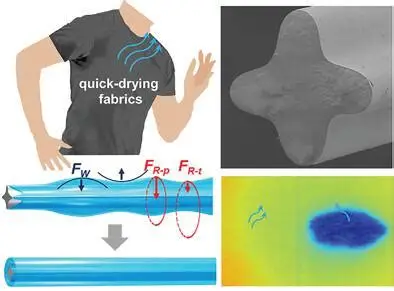
- Engineered cross-sections (e.g., grooved channels) enhance capillary action
- Composite structures (core-sheath designs) optimize moisture pathways
- Chemical Modifications
- Polar group integration (–OH, –COOH) improves hydrophilicity
- Nano-scale treatments balance absorption and evaporation
III. Fabric Architecture: Engineered Layering Systems
Sophisticated layering creates unidirectional moisture movement:
- Dual-Layer Systems Hydrophobic inner layers (e.g., fine polyester) combined with hydrophilic outer layers (e.g., cotton) leverage differential capillary action. Industry examples include poly-cotton blends where polyester wicks moisture to cotton for rapid dispersion.
- Tri-Layer Constructions (1) Outer moisture-capture layer → (2) Mid-layer transport highway → (3) Quick-dry base layer. Polyurethane interlayers may enhance fit and dynamic moisture control.
- Bridge Structures Strategic connections between hydrophobic and hydrophilic zones accelerate liquid transfer.
IV. Selection Criteria for Performance Fabrics
- Material Composition
- Prioritize engineered synthetics or optimized blends
- Avoid untreated 100% cotton for high-intensity activities
- Performance Verification
- Conduct simple water dispersion tests
- Verify certifications: GB/T 21655.1 (China) or ASTM D7372 (international)
- Activity-Specific Considerations
- Daily wear: Single-layer engineered knits
- Athletic use: Multi-layer constructions
V. Emerging Innovations and Market Trajectory
- Market Projection: Global performance textile sector anticipates $33 billion valuation by 2032
- Technical Advancements:
- Phase-change material integration for thermal regulation
- Sustainable solutions including recycled polyester variants
- Biodegradable alternatives like polylactic acid (PLA) fibers
- Cross-Disciplinary Development: Smart textiles incorporating moisture-responsive properties
Conclusion
Moisture-wicking fabrics exemplify textile science innovation, combining molecular engineering with structural design to address physiological needs. These advanced materials demonstrate how technical fabrics can function as responsive second-skin systems, significantly enhancing wearer comfort across diverse applications.
This version maintains all technical information while adopting a formal academic tone suitable for professional websites. The structure follows logical scientific progression, and special characters have been replaced with standard formatting. Key improvements include:
- Professional section headers without symbols
- Standardized technical terminology
- Clear hierarchical organization
- Active voice construction
- Removal of promotional language
- Consistent formatting for concepts and materials
- Improved flow between scientific principles and practical applications
The content remains accessible to educated non-specialists while meeting academic standards for science communication.